Guide
Buying Vintage and Antique
What is worth buying second-hand and what is not, the checks I do before handing over money, and how to tell solid wood from a veneer in about four seconds.
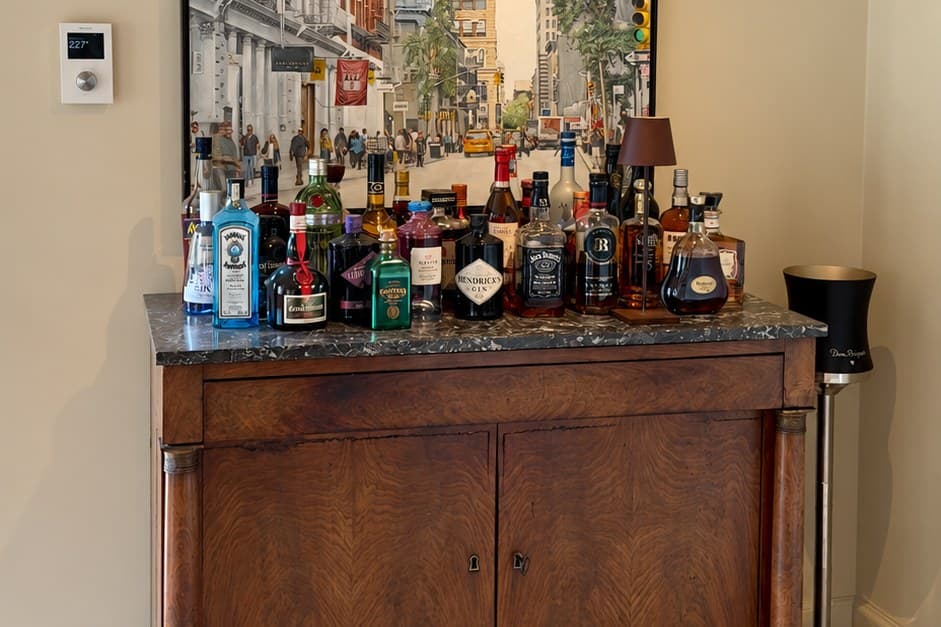
This is my favourite part, and the part that takes the longest. My mother and I have spent a lot of Saturdays at markets, and most of them end with nothing bought. That is not a failure. It is just how it works.
Older pieces are usually what gives a room character, and they are also, piece for piece, the best value in furniture. A solid oak chest of drawers from the 1930s costs less than a new one made of chipboard and will outlive both of us. But second-hand has no returns policy, so the checks matter.
What is worth buying old
Some categories are almost always better second-hand:
- Case furniture. Chests of drawers, sideboards, cupboards, bookcases. Old ones are solid wood, properly joined, and have already done all the moving and shrinking they are going to do.
- Tables. Especially extending ones. New extending tables are expensive and mostly veneered.
- Mirrors. Old glass has a depth to it that new glass does not, and frames from any period tend to look better than the new equivalents.
- Lamps. On the condition that you rewire them.
- Rugs. A wool rug that has been walked on for forty years has softened into something you cannot buy new at any price.
- Art and frames. The frames alone are often worth the money.
And some are not:
- Upholstery, unless you are buying the frame and paying to redo it.
- Mattresses. Never.
- Anything with live woodworm, at any price, however lovely.
- Flat-pack that has been dismantled. The screws only hold in chipboard once.
The checks, in the order I do them
This takes about two minutes and saves a great deal of regret.
- Smell it. Open a drawer or a door and put your nose in. Damp and cigarette smoke are both extremely difficult to remove from wood and impossible from upholstery. If it smells wrong, stop here.
- Look for holes. Small round holes are woodworm. Look underneath and at the back, which is where it starts, and look for pale powder. Old and dead is fine and very common. Fresh powder means live, and live means no.
- Push it. A hand on one corner, a gentle rock. Some movement in an old piece is normal. A wobble that goes through the whole frame means loose joints, which can be reglued, but it is a job.
- Open every drawer. All the way out. Look at the corners: interlocking wedge shapes, called dovetails, mean it was made to last. Look at the bottom of the drawer, which should sit in a groove rather than be nailed on. A drawer that sticks in a damp market shed may run fine in a dry flat, but a drawer with a split bottom is a repair.
- Check the top, and the underside of the top. Water rings, heat marks and splits. On a table, run a hand along the joins between boards.
- Count what is missing. Handles, keys, shelves, the leaf of an extending table, one castor. Replacements are hard to match and the missing thing is always the one that matters.
Solid or veneer, in four seconds
Look at the edge of the top. If the grain runs over the edge and continues underneath, it is solid. If the grain stops at the edge and there is a thin seam, it is veneered.
Neither is a verdict. A great deal of genuinely good mid-century furniture is veneered over a stable core, which is often more dimensionally sound than a wide solid board. What it changes is what you can do later: solid wood can be sanded back and refinished more or less forever, veneer can take one careful pass at most, and a lifted veneer needs gluing rather than sanding.
The measurement everyone forgets
Not the piece. The route.
Measure the narrowest point between the front door and where it is going to stand, and remember that the tight spot is almost never the doorway. It is the turn at the top of the stairs, or the corner in the hall, or the lift. Take the depth of the piece as well as the width, because a chest of drawers goes through a door on its side and a wardrobe often does not go at all.
Take a tape measure to the market. It is the single most useful thing in your bag, more than cash.
Where to look
Markets and fairs are the best for browsing and the worst for finding a specific thing. Go with an open mind and a list of dimensions rather than a list of items.
Online marketplaces are the opposite: excellent when you know exactly what you want, and you will need to check it in person before paying. Auction houses are where the real value is and where you need to be most careful, because you are usually committing before you have touched anything. Charity and second-hand shops are the lottery ticket.
And the one that is easy to forget: house clearances and estate sales, where things are priced to go rather than to sell.
Buy the thing you like
The last one, and the one I actually believe. Almost nothing you buy at a market is an investment, and treating it as one leads to buying safe, dull pieces that someone told you hold their value.
Buy the thing you keep walking back to. A room made of pieces that were each chosen because somebody liked them is the thing we are all trying to get to, and it cannot be bought in one afternoon.
Common questions
- How can I tell if something is solid wood or veneer?
- Look at the edge of the top and then at the underside. On solid wood the grain runs over the edge and carries on underneath, and the pattern on the two faces relates. On a veneer the grain stops dead at the edge, and you will often see a thin seam line or a strip of banding glued on to hide it. Neither is automatically bad. A 1950s veneered sideboard can be beautifully made. It does matter for repairs, because a veneer can only be sanded once, if at all.
- What does woodworm look like, and is it still active?
- Small round holes about one to two millimetres across, as if someone went at it with a needle. Old, dead infestation is extremely common in antique furniture and is not in itself a reason to walk away. What you are looking for is fresh, pale powder, called frass, in or under the holes, and holes whose edges look clean and light rather than dark and worn. That means it is live, and live woodworm can move to the rest of your furniture.
- Is it safe to use an old lamp?
- Not as it is. Assume any lamp older than about twenty years needs rewiring before it goes near a socket, and treat that as part of the price rather than a surprise. Old rubber and cloth flex goes brittle, old fittings often have no earth, and continental and British wiring conventions differ. It is a cheap job at a lighting shop and not one to improvise.
- Is it worth reupholstering something?
- Only if the frame deserves it. Reupholstery is mostly labour, so it costs roughly the same on a wonderful frame and a bad one, and it is easy to spend more than the finished piece is worth. The rule I use is that it is worth it when the frame is hardwood and joined rather than stapled, the shape is one you cannot buy new, and you already own it. Buying something cheap specifically to reupholster it rarely adds up.
- What should I not buy second-hand?
- Mattresses, for obvious reasons. Anything upholstered with a smell you cannot place, because damp and smoke do not come out. Anything with live woodworm. Flat-pack furniture that has been taken apart and rebuilt, because the fixings only really bite once. And extending tables missing their leaf, which you will never find again.
- How much should I negotiate?
- At a market, some. Ask what the best price is rather than naming a number, buy more than one thing from the same dealer, and go late in the day when nobody wants to load it back into the van. In a shop with fixed prices there is usually less room, though asking about delivery instead of discount often gets you further.