Guide
How to Choose a Bouclé Armchair
What bouclé actually is, where the cheap ones go wrong, and the four measurements that decide whether a chair works in your room.
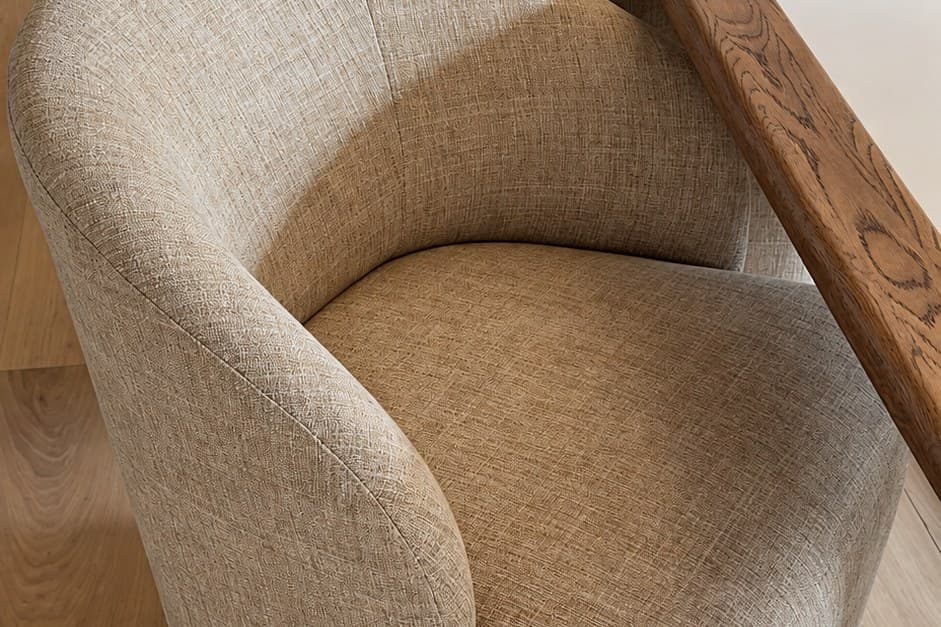
Bouclé went from a fabric nobody outside the trade could spell to the default upholstery of the last decade, which means there is now an enormous amount of bad bouclé on sale. The gap between a good one and a cheap one is not the look in the photograph. It is what the chair is like after a year.
What bouclé actually is
Bouclé is not a material, it is a weave. The yarn is looped before it is woven, so the surface is covered in small curls rather than lying flat. That is where the texture comes from, and it is also where the problems come from.
The fibre underneath can be anything: wool, cotton, polyester, or a blend. That matters more than the word “bouclé” on the label. Wool-rich blends recover their shape and resist flattening. Cheap all-polyester bouclé is what goes shiny and grey across the seat in eighteen months.
If a listing does not tell you the fibre composition, that is usually because it would not help the sale.
The four measurements
Most armchair disappointments are geometry, not quality. Before you look at a single photograph, measure:
- Overall width. The gap it has to live in, minus about 15cm. Over 85cm and it starts behaving like a small sofa.
- Seat height. Around 42 to 45cm suits most people. Lower feels loungey and is harder to get out of; higher feels like a dining chair.
- Seat depth. Under about 50cm and a tall person perches. Over 60cm and a shorter person needs a cushion behind them to reach the back.
- The door. Measure the narrowest point on the route in, usually a stairwell turn, not the doorway itself. Armchairs are the single most common piece to arrive and not fit.
Where the cheap ones go wrong
Three things, in the order you will notice them:
- The loops pull. A big, loose, chunky loop photographs beautifully and snags on a zip, a watch strap or a claw. A tighter, smaller loop is less dramatic and survives.
- The seat flattens. Foam density is rarely published. A useful proxy is weight: a chair of this size under about 15kg is usually light on frame and filling both.
- The legs are an afterthought. Screw-in tapered legs on a metal plate work loose. A frame where the leg is part of the structure does not.
Colour, in a dark room
The cream-on-dark combination is the whole look in one line, and it is easier to get right in bouclé than in almost anything else, because the looped surface reads as warm rather than stark.
If you want to keep the texture but lose the pale colour, velvet is the other route to the same feeling, heavier, more formal, and it shows a pressure mark where bouclé shows a snag. Neither is objectively better. They fail differently.
What I would actually buy
Below are the pieces from my current catalogue that fit the brief: a tight weave, a compact frame, and a leg that looks structural. Prices come straight from the retailers, so they are today’s prices, in euros, exactly as the retailer charges them.
The pieces
3 pieces
- Image
Ilsley Boucle Armchair (affiliate link to Halden Home, opens in a new tab)
€429at Halden Home
A compact frame, which is the hard thing to find under €500.
Ships to Ireland, the UK and Australia, not the US
- Image
Lavaux Boucle Daybed (affiliate link to Maison Duroc, opens in a new tab)
€1,290at Maison Duroc
The same fabric in a piece that seats two. Ships within the EU only.
Ships to the EU, not the UK, the US or Australia
- Image
Bramley Velvet Club Chair (affiliate link to Aldermoor & Co., opens in a new tab)
€1,450was €1,625at Aldermoor & Co.
If you want the deeper, heavier version of this shape, velvet is the other route to it.
Ships to Ireland and the UK, not the US or Australia
Common questions
- Is bouclé hard to keep clean?
- It is a looped fabric, so it traps more than a flat weave does, and the loops are what snag. Check the cleaning code before you buy. W or WS means you can spot-clean it at home, S means solvent only. Most manufacturers do not recommend a steam cleaner on bouclé.
- Is bouclé bad with pets?
- Claws catch in the loops, and a pulled loop on bouclé does not recover the way a pulled thread on a flat weave does. If you have a cat, look for a tight, short loop rather than a big chunky one, and check whether the maker offers a replaceable cover.
- What is the difference between bouclé and teddy fabric?
- Bouclé is woven from a looped yarn, so you can see individual loops. Teddy is a pile fabric, closer to fleece, brushed rather than looped. Teddy is usually cheaper and tends to flatten in the seat over time.
- Does bouclé work in a dark room?
- It is one of the few pale fabrics that does. The looped surface catches low light and holds a little of it, so a cream chair reads warm against a dark wall rather than as a bright hole in the middle of the room.
- How wide should an armchair be?
- Measure the gap it has to sit in and take 15cm off for breathing room. Anything over about 85cm wide starts to read as a small sofa, which is fine in a big room and dominating in a small one.